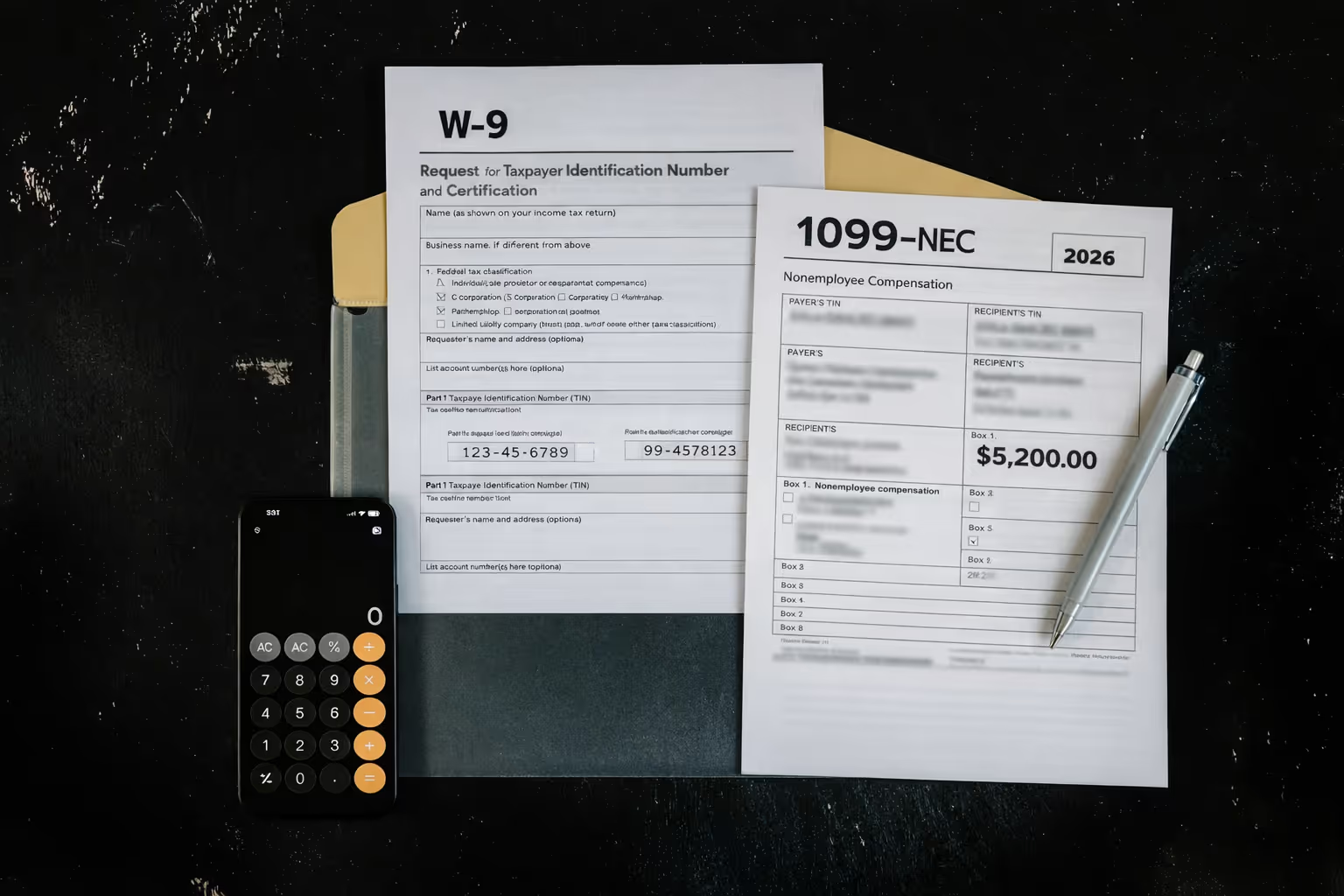

For any business that hires outside talent or for any freelancer working for clients, tax paperwork looms large. The central point of confusion often revolves around two forms: the W-9 and the 1099. Knowing the W9 vs. 1099 rules keeps you out of trouble with the IRS. These forms represent two distinct steps in the same mandatory reporting cycle. One form collects data; the other reports that data to the government.
This guide cuts through the jargon. We're going to explain precisely what each form is for, who needs to complete it, who issues it, and the critical timelines involved.
Figuring out the 1099 and W9 difference is just critical for dodging those IRS penalties. We're laying out the simple rules here, just for you, so you can handle contractor taxes confidently. That’s the goal.
The truth is, if you skip this step or mix up the process, you risk both annoyance and actual financial hits from the IRS. It's not worth the headache, so stick with us to get this sorted out. Contractors really need to watch this closely, too.
If you're out there wondering if W9 and 1099 are the same thing, you’ve already got a blind spot for a really important detail. These forms have specific jobs, specific jobs they were created for, and getting them wrong just means a mountain of extra paperwork down the road. You don't want that hassle. We focus on giving you clarity right now.
What Is a W9 Form?
The W-9 form, titled "Request for Taxpayer Identification Number and Certification," is purely an information-gathering tool. Its entire function is to capture the correct identifying data from a vendor before any money changes hands. Think of it as the prerequisite step for any contractor relationship.
The form requires the contractor to supply their legal name, address, and their Taxpayer Identification Number (TIN). For individuals, this is typically their Social Security Number (SSN).
For entities like LLCs or corporations, it’s usually an Employer Identification Number (EIN). The contractor signs the form, putting their name on the line that this information is correct for the IRS. That's the certification part.
Who Needs to Fill Out a W9?
If you are an independent worker getting paid by a company, you are expected to hand over a W-9. This goes for sole proprietors, partnerships, and even corporations; any entity that is not on the client’s standard payroll as a W-2 employee.
Here is the key benchmark: Any time a business pays a non-employee $600 or more in a calendar year, they absolutely need that worker’s W-9 kept safely on file. This is the standard for anyone working as an independent contractor w9 or 1099 worker.
When Is a W9 Required?
The timing here is vital. A business must get the signed W-9 from the contractor before issuing the first payment.
Waiting until the end of the year invites risk. If a contractor gives you an incorrect TIN, the business faces penalties known as backup withholding. This forces the business to withhold $24\%$ of future payments and send that amount directly to the IRS until a correct TIN is supplied. Asking for the W-9 during initial onboarding prevents this whole headache.
What Is a 1099 Form?
The 1099 is what the business actually sends to the IRS. It’s the official document confirming that expense deduction. It reports that non-employee income was paid out during the previous tax year.
Now, when a contractor receives that 1099, it’s a clear signal. They must report that income on their own tax return, which almost always means they have to deal with self-employment tax, too. That’s how the loop closes.
Types of 1099 Forms (NEC vs MISC)
The forms taxpayers deal with most often are the 1099-NEC and the 1099-MISC.
- Form 1099-NEC (Nonemployee Compensation): This is the primary form for reporting payments for services rendered by independent contractors. If you paid someone for writing, graphic design, or maybe consulting, and that total hits the reporting threshold, you use the 1099-NEC. It's the standard for contractor services.
- Form 1099-MISC (Miscellaneous Information): This form is kept around for other payments, stuff that's not for services. Think of payments like rent you made to a property owner, royalties, or maybe some prizes you gave out. Make sure you don't file the wrong one, period.
For most service-based freelancers, the focus must be on the 1099-NEC. Distinguishing what the difference is between w9 and 1099 forms often comes down to knowing the current 1099 variant for services.
Who Receives a 1099?
The recipient of the 1099 is the contractor who performed the work. Any vendor who collected $\$600$ or more from your business in a calendar year must get a copy. This form is the basis for the contractor to calculate their income tax and self-employment tax obligations.
When to Issue a 1099
Businesses have a hard deadline for issuing 1099s. Both the recipient and the IRS must have their copies by January 31st of the year after the money was paid.
For example, all 2025 contract payments must be reported on 1099s mailed out by January 31, 2026. Missing this date results in mandatory IRS penalties against the paying business.
W9 vs 1099: What’s the Difference?
The key distinction is one of sequence and recipient. They are related documents, but they are not interchangeable—are W9 and 1099 the same thing? It is a question with a clear negative answer.
Purpose of Each Form
The W-9 is a defensive tool for the payer. It collects the TIN required for tax filing. The 1099 is an external reporting document that officially notifies the IRS of the income paid.
The information gathered on the W-9 directly populates the final 1099 form.
Who Uses Them
The contractor completes and gives the W-9 to the business. The business then uses that information to complete and issue the 1099 back to the contractor and the IRS.
Here’s how the flow works: The contractor hands over the W-9, and the business, the client, is the one that issues the 1099 later on. Simple as that.
Filing and Reporting Differences
The W-9 stays within the business’s private records. It is an internal audit-ready document. You keep it in your files for several years.
The 1099, conversely, must be sent outside your organization to the government. The W9 tax form vs 1099 difference is file retention versus mandated filing.
Common Mistakes with W9 and 1099 Forms
Truthfully, a lot of businesses, especially the ones growing fast, make simple mistakes with these forms. Simple errors that are exactly what lead to unnecessary scrutiny from the IRS. You need to be better than that.
Not Collecting a W9 on Time
Failing to collect the W-9 upfront is the leading error. When a new contractor starts, the W-9 should be the very first piece of paperwork they sign. This sets up the necessary information for year-end reporting. A client paying someone for services without a W-9 risks having to pay backup withholding taxes on that person's income.
Filing the Wrong 1099 Form
Using the wrong 1099 is common after the IRS updated its forms. If you pay a consultant for their work, that is nonemployee compensation reported on the 1099-NEC. If you mistakenly use the 1099-MISC for service fees, the IRS computer systems flag the discrepancy.
Penalties for Misclassification
This mistake goes beyond the forms themselves but is strongly related to them. Businesses often issue 1099s when the worker legally should have been an employee receiving a W-2. The IRS takes this issue seriously because it involves unpaid Social Security, Medicare, and unemployment taxes. If you are paying someone consistently for ongoing services, you must confirm their status. Do not just assume a W9 for a 1099 employee scenario is acceptable.
Best Practices for Contractors and Businesses
To keep things simple and compliant, set up systems that work automatically.
Keeping Records Organized
A business needs a secure, central location—digital storage is best—for all collected W-9s. Maintaining this level of organization often requires consistent bookkeeping processes, especially for businesses managing multiple contractors and payment records. For contractors, maintain copies of all 1099s you get. Reconcile those 1099s against your actual income tracking as soon as you receive them in January. This helps spot any errors or missing income forms quickly.
Using Accounting Tools for Compliance
Automation handles repetition best. Investing in good accounting software minimizes manual entry and the chance of error. Such tools track payment thresholds automatically and generate the necessary 1099s based on the vendor data collected from the W-9s. Good Tax Accounting relies on these efficient systems. The real value comes when you use these tools to streamline processes, like those handled by Bob's Bookkeepers.
When to Seek Professional Tax Help
For businesses dealing with international payments, complex multi-state operations, or high numbers of vendors, consulting a specialist is wise. A tax professional can review your contractor agreements and payment structures to ensure proper classification, which is the most significant potential liability. For personalized help setting up these compliance safeguards, consider our Tax Accounting services.
Summary of Contractor Tax Documents
Handling these documents correctly prevents fines and speeds up year-end processing for everyone involved. Remember that the W-9 is the foundation, providing the correct TIN before work begins. The 1099, usually the 1099-NEC, is the final report sent to the government after the year ends.
Here are the key documents and actions to keep in mind:
- Contractor completes W-9: Provides name, address, and TIN to the business before payment.
- Business files W-9: Retains this form internally for audit proof.
- Business tracks payments: Records all payments made to non-employees exceeding the IRS threshold.
- Business issues 1099-NEC: Sends copies to the contractor and the IRS by January 31st.
By establishing these procedures early, you streamline your 1099 and W9 differences understanding and simplify your annual tax filing. Stay diligent with your paperwork to keep your business in good standing.